Medical certificate for long-term stay abroad: costs
Would you rather arrange this straight away?
View our ratesA departure date may already be set, while it is still unclear which medical certificate you need. The required examination depends on your application. Inquire in advance how much time you should allow for your certificate.
It is understandable that you want clarity in advance regarding preparation, costs, and the validity of the certificate. These requirements depend on the purpose of your stay and the documents you need to submit. Therefore, a standard certificate is not automatically suitable for every application.
In this article, you will read when a medical examination may be necessary, what tests may be involved, and how quickly you will receive the certificate. You will also discover what factors influence the costs and how to assess whether the validity of a standard certificate aligns with your application. This way, you can better prepare for your departure and know which steps to arrange on time.
Key Points
- Discover when a medical examination may be necessary, for example for work, study, or emigration.
- Read about the tests that may be included in an examination and how much time the processing may take.
- Gain insight into the validity of a standard certificate and why the purpose of your application matters.
- Learn what you can arrange in advance to ensure your examination and departure are properly aligned.
How quickly do I receive the medical certificate?
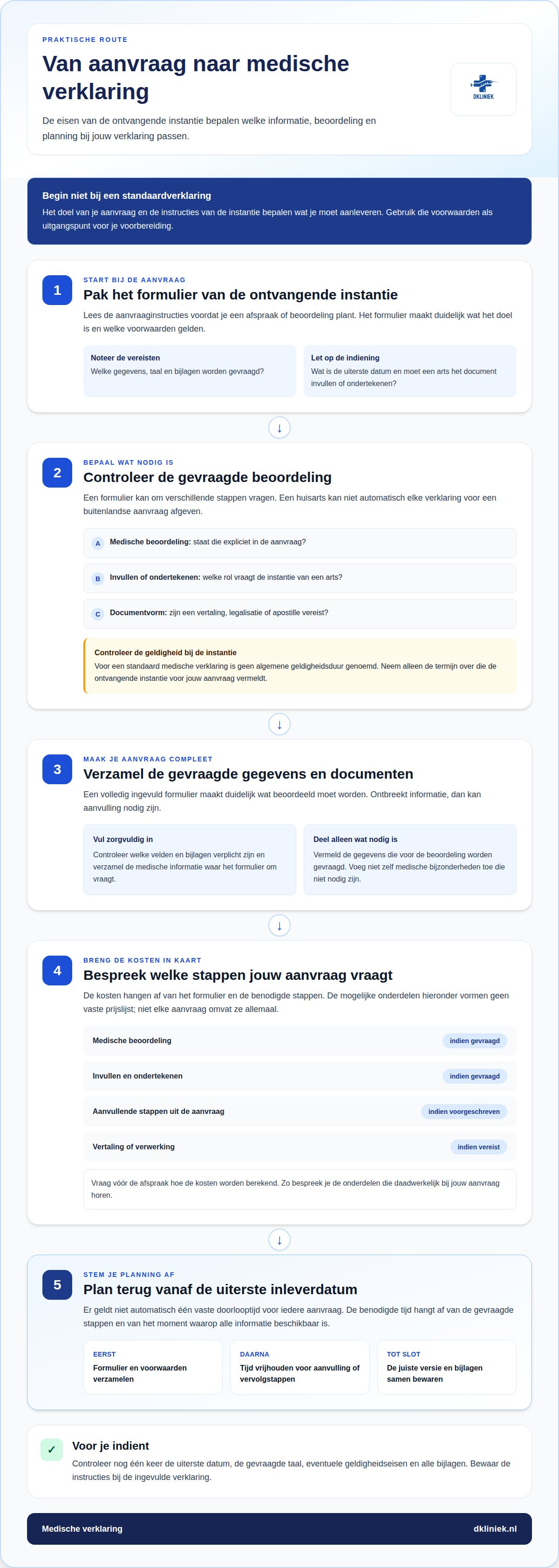
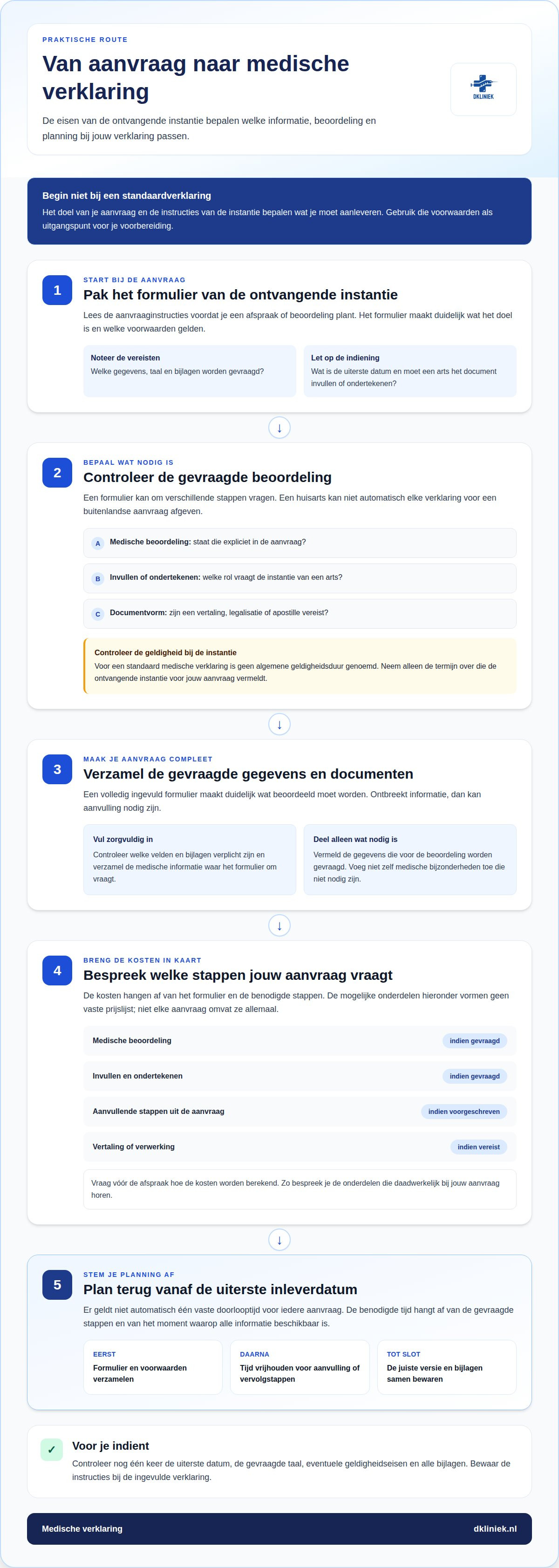
What you need to provide depends on the requirements of your application. A fully completed form clarifies the purpose, which assessment is requested, and which attachments are needed. If information is missing, supplementary details may be required. Therefore, check in advance which sections you need to fill in and which documents you must attach.
Start with the form from the receiving authority. Note what details and language are required and what the submission deadline is. Also check whether a doctor needs to complete or sign the document. This allows you to plan the steps for your application in the correct order.
The available information determines how quickly you can proceed. An application with a clear purpose and complete documentation requires less investigation than a form with missing components. Therefore, gather the relevant application instructions and medical information requested by the form in advance. This allows the assessment to focus on what is needed for your document.
A general practitioner (GP) cannot automatically issue every certificate for a foreign application. This depends on the form and what the receiving authority requires. Check whether the document requires a medical assessment, a signature, or simply completed details. These requirements determine which step is appropriate for your situation.
Only provide information requested by the form for the assessment. A certificate does not necessarily need to contain all medical details. Share supplementary information only if it is necessary for the purpose of the document. Read the fields carefully and do not add unsolicited medical details yourself.
Whether you need a translation, legalization, or an apostille depends on the instructions of the receiving authority. Check which language and document format are required for your application. A translation and legalization are not the same thing, and one does not automatically replace the other. Keep these requirements together with the form.
Plan the application well ahead of the submission deadline and allow time for any supplementary details or further instructions. This ensures you can respond if the authority still requires information. Keep the completed form and the accompanying documents together, so you submit the correct version.
Validity of a standard medical certificate
No general validity period can be specified for a standard medical certificate. The official information available for this article does not define a set timeframe. Therefore, do not assume an arbitrary number of days or months as a validity rule. The application requirements of the authority receiving your document are the baseline for the application.
Check the instructions for an expiration date, a timeframe starting from the medical assessment, or a requirement that the certificate must be issued on a specific date. These wordings do not mean the same thing. A timeframe starting from the assessment begins at a different moment than a fixed deadline. Note down the exact phrasing your form uses.
Before having the certificate completed, compare the following points:
- The date by which you must submit the application.
- Any deadline stated on the form.
- Any validity timeframe calculated from the date of the assessment.
- The name of the authority receiving the certificate.
If the application does not state a validity period, do not infer one from the word "standard". That word in itself does not indicate how long a document will be accepted for your application. Base your planning on the written instructions for your procedure. This prevents you from adopting a timeframe from a different application.
Keep the application instructions together with the completed certificate. If you later receive a different form, compare the terms and conditions again. A document for an employer may have different administrative requirements than a document for an educational institution. The specific application is decisive, not just the title of the certificate.
Only adhere to a validity period stated by the receiving authority for your specific application. Without such a timeframe, you cannot infer the validity from the term "standard certificate". This prevents you from mistakenly considering a document as valid or expired.
Costs and turnaround time of the medical examination
The costs and scheduling depend on what your application requires. A form requiring only details and a signature involves different steps than an application requiring a comprehensive medical assessment. Therefore, do not base your budget and timeline on an estimate of your own, but on the required steps.
Start with the application instructions and check which sections need to be completed. Note whether an assessment, a signature, or additional documents are needed. This allows you to discuss what the application entails in advance. Not only the destination, but also the form and the specific purpose determine which steps are necessary.
For your own overview, distinguish between potential cost items:
- The medical assessment required for the form.
- Completing and signing the certificate.
- Any additional steps prescribed by the application itself.
- Translation or processing if required by the receiving authority.
This list helps you discuss the application, but it is not a fixed price list. Not every application includes all of these components. Note which steps are listed on your form and ask before the appointment how the costs are calculated. This prevents you from treating different documents or services as a single lump sum.
Start with the correct form and the instructions from the receiving authority. After that, it becomes clear which assessment or signature is required. The timeline depends on these steps and the point at which all necessary information is available. A single fixed turnaround time does not automatically apply to every application.
Plan your appointment backwards from the final submission deadline. Keep time free to complete the form and arrange any follow-up steps. Also keep the application requirements and cost agreements together. This will show you which documents are still missing before you submit the certificate.
When a medical certificate is needed for a long-term stay abroad
A medical examination may be required for a work permit, student visa, or internship. A certificate may also be requested for a long-term family stay or emigration. The receiving authority determines which documents belong with your application. Therefore, start with the instructions for your visa or residence permit, not with an arbitrary standard form.
Requirements vary by country and application. Instructions may dictate which form to use, what information is required, and who must sign the document. Some applications require a medical assessment, while others require a specifically completed form. Follow the directions of the authority processing your application and use the correct version.
A missing or incorrectly completed certificate can render your application incomplete. The authority may then request supplementary information or a new form, delaying the processing. An incorrect certificate may also contain information that does not align with the purpose of your application, such as work or study.
Follow these steps as soon as you receive the application requirements:
- Note which form and medical assessment the authority requires.
- Check the required language, signature requirements, and submission deadline.
- Bring the official form and valid identification to the examination.
- Allow sufficient processing time before the date the documents must be submitted.
Check with the CAK (Central Administration Bureau) regarding the applicable deadline for sending a certificate. Keep this deadline separate from the requirements for a visa or residence permit.
For long-term stays for work, study, or emigration, the specific application is decisive. First, collect the instructions from your employer, educational institution, or immigration authority. This ensures you know which form needs to be completed and which examination is appropriate. Schedule your medical assessment as soon as you have the application requirements.
DKliniek: Medical certificate
DKliniek provides medical certificates for long-term stays, work, or study abroad. Bring the official form from the receiving authority and a valid ID. This ensures the necessary information is available to tailor the certificate to your application.
Are you unsure which certificate fits your application? Discuss the purpose of your stay and the instructions you have received. This allows the assessment to match the documents you need to submit. You can also visit DKliniek for travel vaccinations.
Schedule an appointment directly at DKliniek.
Complete your preparations
Use the application requirements as a starting point. A medical certificate for a long-term stay abroad must align with the purpose of your stay and the documents requested by the receiving authority. Bring this information together to discuss your medical preparation in a targeted manner and avoid having the certificate detached from your application.
Also include your destination and travel plans in the consultation. If you need travel vaccinations, discuss which vaccines are appropriate for your trip. Inquire at DKliniek about options for travel vaccinations. Which vaccinations are relevant depends on your destination and personal health situation.
Would you like to discuss your application or medical preparation? Schedule an appointment directly at DKliniek. This allows you to proceed with greater clarity on your plans abroad.
Frequently Asked Questions
When is a medical certificate required for a long-term stay abroad?
A medical certificate may be required for work, study, an internship, a long-term family stay, or emigration. The receiving authority determines whether your application requires such a document. Read the instructions for your visa or residency application before scheduling an examination. This prevents you from obtaining a certificate that does not match the purpose or required form. A medical certificate for a long-term stay abroad must match your specific application.
Who in the Netherlands is authorized to issue a medical certificate for a stay abroad?
The authority processing your foreign application determines who must complete or sign the certificate. There is no single universal form or issuance procedure for every destination. Follow the instructions accompanying your application and check which medical assessment is required. DKliniek provides medical certificates. Bring the application instructions with you so the assessment can be aligned with the requested document.
Can a GP issue a certificate for a foreign residency application?
A general practitioner (GP) can check and sign certain certificates, such as a medication certificate. However, this does not automatically mean that such a certificate suffices for a foreign residency application. The purpose and the official form are decisive. Therefore, first establish what the receiving authority requires. A medication certificate and a medical certificate for a long-term stay abroad can be different documents with distinct purposes.
How long is a medical certificate valid for a foreign residency application?
The validity period depends on the conditions set by the authority processing your application. A certificate reflects the medical assessment at the time it was issued. Therefore, do not automatically reuse it for a later application or a different purpose. Check the deadline and required format in the application instructions and schedule the date of your examination accordingly.
What does a medical examination or certificate for staying abroad cost?
Consult the rates page on the official DKliniek website for information regarding costs. Whether costs are reimbursed is not stated here. Inquire about this with your health insurance provider before booking an appointment. Also check with the authority processing your application to see which assessment is required, so you can ask about the specific costs accurately.
What rules apply to medical certificates for long-term stays in popular destinations?
Even for popular destinations, requirements vary by country, application purpose, and the receiving authority. Use the specific form that corresponds to your visa, work, or study application. Verify the required language, signature, and submission timeframe. A document that is suitable for one destination does not automatically suffice for another. Therefore, always follow the application instructions, even if others are traveling to the same destination.
Schedule an appointment directly at DKliniek.

Article by
Y. Daia
Yassine Daia, MD, is a physician specializing in travel medicine and vaccinations. As the founder of DKliniek, he advises and guides travelers on safely preparing for their journeys, focusing on personal health and destination-specific risks. DKliniek is officially affiliated with the LCR (National Coordination Centre for Travel Advice) and provides expert, reliable travel health advice, including vaccinations for the Hajj and Umrah, among others.
Disclaimer
The information on this page is intended solely for general informational purposes and does not substitute for personalized medical advice. For tailored advice aligned with your health and travel destination, we recommend booking a consultation at DKliniek. Although we compile the information with great care, no rights can be derived from it. DKliniek is not liable for any damages resulting from the use of this information.