
What is the HPV virus? All about symptoms, risks, and vaccination in 2026
Did you know that an estimated 80 percent of the population will be infected with the HPV virus at least once in their lifetime? This impressive percentage explains why there are so many questions about the risks and the long-term health consequences. It is perfectly understandable to be concerned about the link to cancer or to wonder if vaccination at a later age is still beneficial for your specific situation.
At DKliniek, we believe that knowledge is the first step towards peace of mind and prevention. In this article, you will discover exactly how to protect yourself and your loved ones from the harmful effects of this virus. We will clarify the routes of infection and explain which symptoms you should monitor. Additionally, you will gain clarity about the benefits of vaccination in 2026, so you can confidently make the right choice for your own care pathway and well-being. Our specialists are ready to provide you with personalised advice tailored to your medical needs.
Key Points
- Learn the crucial difference between low-risk and high-risk types of the human papillomavirus and their direct impact on your health.
- Discover why the HPV virus is the most common infection and how transmission can easily occur through skin-to-skin contact.
- Understand why an infection often goes unnoticed and how to recognise the process of cellular changes leading to serious types of cancer.
- Discover the power of prevention and why the HPV vaccination offers extremely effective protection, even for adults up to 45 years of age.
- Read how you can benefit from personal, expert care at DKliniek, without long waiting times, for your optimal protection.
What exactly is the Human Papillomavirus (HPV)?
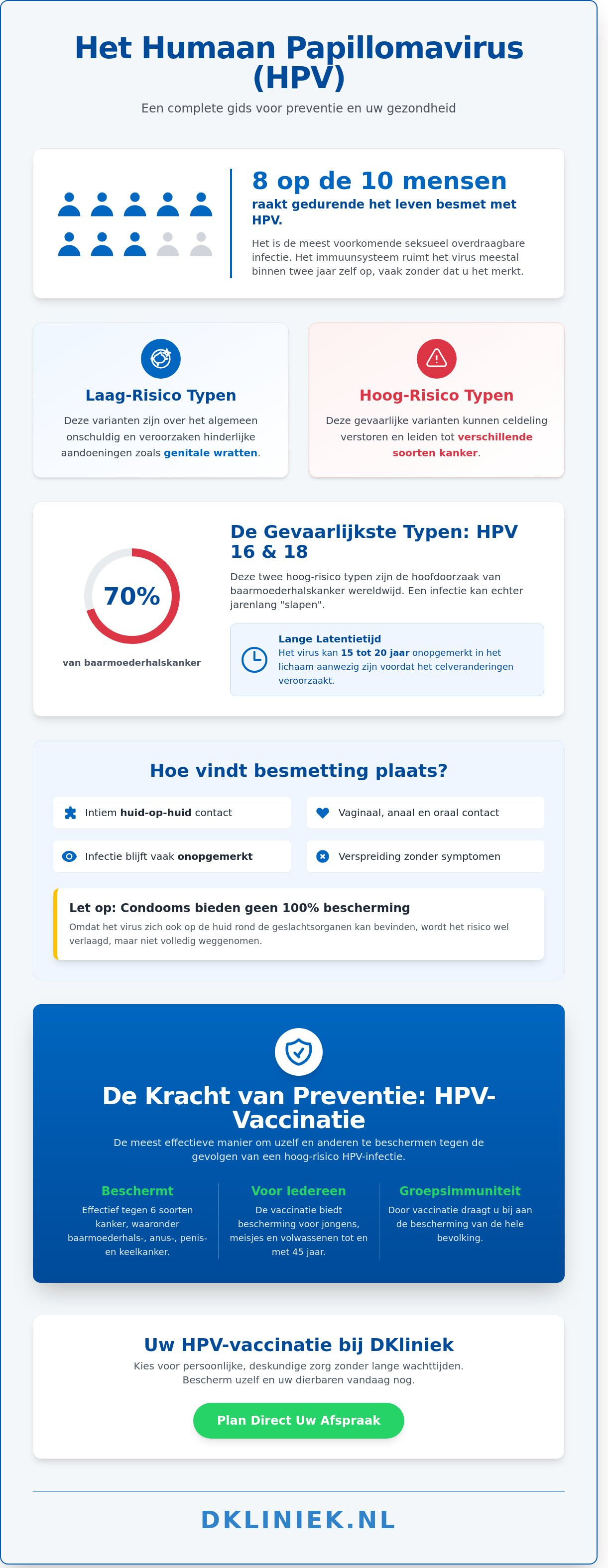
The Human Papillomavirus (HPV) is not a single virus, but a collective name for a group of over 100 different virus types. It is one of the most common infections in contemporary society. Figures show that approximately 80% of people are infected with the HPV virus at least once in their lives. Fortunately, most infections go unnoticed. In many cases, your immune system clears the virus independently within two years. Nevertheless, prevention remains a crucial part of modern healthcare, as the virus can have serious consequences for a specific group of patients.
Medically, we divide the different types into two main categories:
- Low-risk types: These variants typically cause harmless but bothersome warts on the skin or mucous membranes, such as genital warts.
- High-risk types: These variants are more dangerous. They can disrupt natural cell division and, in the long term, lead to various forms of cancer.
The science behind the virus
The HPV virus penetrates the deeper layers of the skin or mucous membranes through microscopic damage. Once inside, the virus embeds itself in the nucleus of your cells. This allows the virus to effectively remain invisible to your immune system. Types 16 and 18, in particular, are medically highly relevant; together, they are responsible for approximately 70% of all cases of cervical cancer worldwide. The virus can remain dormant in the body for up to 15 to 20 years before actual cellular changes occur.
Why we are hearing more about it in 2026
In 2026, awareness of HPV is greater than ever. New medical insights confirm that timely prevention not only prevents cervical cancer but also effectively protects against five other types of cancer, including penile, anal, and throat cancer. National vaccination policy has changed dramatically in recent years. Where the focus previously lay primarily on young girls, boys and young adults are now actively involved in the protection strategy. The threshold for vaccination has been lowered to minimise spread within the entire population and build herd immunity.
This period of young adulthood often marks significant steps towards independence and the future. Alongside health choices, obtaining a driving licence is one such step for many. For our readers in Denmark considering this step, you can discover Brinks Køreskole for professional guidance.
DKliniek advises you not to wait until you receive a formal invitation. By taking action now, you protect yourself and your loved ones against the risks of a chronic infection. Our specialists offer you the personal attention and medical expertise needed to make an informed choice for your health. We understand that these can be sensitive topics and therefore create a trusted environment for all your questions.
Book an appointment directly with DKliniek.
Transmission and risk factors: How do you contract HPV?
The HPV virus is the most common sexually transmitted infection in the Netherlands. Research indicates that approximately 80% of sexually active individuals contract an infection at least once in their lives. A common misconception is that transmission is only possible through full penetration. The reality is different. The virus spreads through intimate skin-to-skin contact in the genital area, meaning that foreplay and intense physical contact also carry risks.
Many people rely entirely on condoms for protection. While a condom significantly reduces the chance of transmission, it does not offer 100% guarantee. The virus can also be present on the skin around the genitals that is not covered by the condom. Additionally, monogamy is not a watertight shield. The virus can remain inactive in the body for years without you noticing. An infection that becomes visible now could be the result of contact from years ago.
Methods of transmission
Transmission occurs through microscopic damage to the skin or mucous membranes. In addition to vaginal and anal contact, transmission through oral sex is an important route. Even through the hands, the virus can pass from one person to another. The insidious nature of the HPV virus is that you usually have no symptoms. You can therefore unknowingly spread the virus to your partner. For more information on preventative measures, you can visit the American Cancer Society, which clearly explains everything about the HPV vaccination and its scientific background.
Who is at risk?
Everyone who is sexually active is at risk, regardless of orientation or gender. It is a myth that the virus only affects young people or those with multiple partners. However, the strength of your immune system plays a significant role. In approximately 90% of cases, the body clears the virus independently within 18 to 24 months. If the immune system is weakened, the virus gets the chance to embed itself in the cells and cause damage. This can ultimately lead to warts or, in serious cases, cancer.
Certain groups have a higher risk of long-term infection or complications. It is wise to know if you need to be extra vigilant. You can read more about this on our page about risk groups for a clear overview of the medical context. At DKliniek, we understand that you have questions about your personal situation, and we are happy to offer a calm environment for an expert consultation.
Would you like certainty about your protection or do you need personal medical advice? Book an appointment directly with DKliniek.
From virus to disease: Symptoms and the link to cancer
An infection with the HPV virus almost always proceeds silently. Your body clears the virus completely independently in approximately 80% of cases within two years, without you ever noticing anything. It is precisely this absence of immediate symptoms that makes the virus so insidious. If your immune system does not effectively combat the virus, it remains present in the cells of the skin or mucous membranes. This is then referred to as a chronic infection, which can form the basis for later health problems.
Recognising symptoms (or the lack thereof)
In its initial phase, HPV gives no signals whatsoever. You feel no pain, have no fever, and see no rash. The only visible manifestations of an infection are genital warts. These are caused by the so-called 'low-risk' variants of the virus, such as types 6 and 11. Although these warts are harmless to your general health, they are highly contagious and often cosmetically bothersome. They appear as small, cauliflower-like bumps around the genitals or anus.
It is crucial to understand that the dangerous variants of the HPV virus, the 'high-risk' types, do not cause warts. These types change cells in an invisible way. For women in the Netherlands, it is therefore very important to participate in the population screening. Through a smear test, practitioners can detect cellular abnormalities long before physical symptoms appear. If you notice any unusual spots or warts yourself, it is advisable to contact a specialist immediately for an accurate diagnosis.
HPV and cancer: A long-term process
The development from an HPV infection to cancer is not a sudden event. It is a process that often takes 10 to 15 years. During these years, the virus embeds itself in the DNA of your cells, causing them to divide uncontrollably. Types 16 and 18, in particular, are known for their aggressive nature in causing malignant abnormalities.
Although cervical cancer is the best-known form, HPV can lead to six different types of cancer in both men and women:
- Cervical cancer: The most common form, almost always caused by HPV.
- Anal cancer: A risk that applies to both men and women.
- Penile cancer: A rare but serious form of cancer in men.
- Oropharyngeal cancer: Tumours in the mouth, throat, and behind the tongue.
- Vaginal cancer: Cancer in the birth canal.
- Vulval cancer: Cancer of the external female genitalia.
At DKliniek, we offer you the expertise and personal attention needed for such sensitive medical matters. Our specialists ensure prompt and discrete handling of your query in a trusted environment. Thanks to short waiting times and our close cooperation with general practitioners, you quickly gain the clarity you seek.
The power of prevention: All about the HPV vaccination
The HPV vaccination is one of the most effective medical tools to prevent various forms of cancer. The vaccine works by training your immune system. It mimics the outer surface of the virus, causing your body to produce antibodies without you actually becoming ill. If you later come into contact with the actual HPV virus, your immune system immediately recognises it and clears the viral particles before they can infect your cells.
Contrary to common belief, the jab is not only useful for young teenagers. Research shows that the vaccine remains highly effective for adults up to the age of 45. Even if you have already been sexually active, vaccination is a sensible choice. It is unlikely that you have already been infected with *all* the variants against which the vaccine protects. By getting vaccinated, you significantly reduce the risk of future infections and the resulting complications.
Safety is a crucial aspect of our care at DKliniek. The vaccines have been administered millions of times worldwide and extensively tested. Possible side effects are usually mild and disappear within one to two days. The most common complaints are a tender spot on the upper arm, slight muscle pain, or temporary fatigue. These reactions are actually a sign that your immune system is working hard to build the desired protection.
The vaccination schedule
For complete and long-lasting protection, following the correct schedule is essential. While young people often only need two jabs, adults aged 15 and over typically require three doses. The standard interval is as follows: the second jab follows two months after the first, and the third jab is given six months after the start. Did you accidentally miss an appointment? You do not need to restart the series. We will schedule the next dose as soon as possible to safely complete your course.
Vaccination for adults
Men are increasingly opting for vaccination against the HPV virus, and this is a positive development. For men, the virus not only causes genital warts but also increases the risk of anal, penile, and throat cancer. An important advantage of modern vaccines is cross-protection. This means that the vaccine not only protects against the most aggressive types but often also offers a degree of defence against related viral variants. For a transparent overview of the investment in your health, you can consult our tariff page.
Do you want to optimally protect yourself against the risks of HPV? Our specialists are ready to provide you with personal advice and expert care.
Book an appointment directly with DKliniek.Your HPV vaccination at DKliniek: What can you expect?
At DKliniek, your health is our priority. Our specialists adopt an approach that combines medical expertise with genuine personal attention. This is crucial for preventative care, such as protection against the HPV virus. You will be treated by experienced practitioners who understand that you may have questions about effectiveness or the procedure. A significant advantage of our clinic is its efficiency; we do not have long waiting times. Where you might wait weeks at larger institutions, at our locations in Amsterdam and Badhoevedorp, you can usually get your first jab within 48 hours. This swift service ensures you take immediate steps towards better protection without unnecessary delay.
Guidance at DKliniek does not stop at the medical procedure itself. We guide you through the entire process, from initial information to the registration of follow-up doses. Our specialists create a calm, trusted environment where you feel at ease. We believe that preventative care should be accessible and transparent, so you know exactly what to expect regarding your immunity. Our aftercare is standard; you remain in our comfortable waiting area for 15 minutes after the vaccination so we can ensure you feel well before leaving the clinic.
How does the consultation proceed?
The process always begins with a thorough discussion of your current health situation. The practitioner will discuss your medical history and check for any specific considerations. We believe it is important that you are fully informed before treatment begins. During the consultation, you will have ample opportunity to ask questions about the vaccination series and its efficacy. The practitioner explains how the body responds to the vaccine and which intervals are necessary for optimal protection. After administration, we carefully record your vaccination digitally. Our aftercare is standard; you remain in our comfortable waiting area for 15 minutes after the vaccination so we can ensure you feel well before leaving the clinic.
Take charge of your health today
Delaying vaccination against the HPV virus prolongs the period in which you are unprotected against infections that can have serious consequences later in life. In 2026, access to preventative care is easier than ever, but the initiative lies with you. We make it as easy as possible for you to receive this care. Scheduling your visit via our online agenda takes only two minutes. You choose a time that fits into your daily schedule, so care is organised around your life. Our transparent approach and the small-scale setup of our clinic remove every barrier to vaccination. Choose the expertise of our practitioners and the speed of our services to secure your future.
Book an appointment directly with DKliniek.
Protect your future with the right prevention
The HPV virus remains one of the most common infections, but with the right knowledge and preventative measures, you retain control over your health. Vaccination, according to official medical guidelines, is the most effective way to drastically reduce the risk of serious complications, such as various forms of cancer. At DKliniek, we understand that you need clarity and a safe environment for your medical questions. Our practitioners not only provide the necessary inoculations but also offer personalised advice that is fully aligned with the current health standards of 2026.
By focusing on short waiting times and quick accessibility, you never have to wait long for the care you deserve. Whether you live in Amsterdam or Badhoevedorp; we guarantee professional treatment in a trusted setting. Your well-being is our priority, and prevention is an essential part of that. Take responsibility for your body today and choose the expertise of our specialists. We look forward to welcoming you to our clinic.
Book an appointment directly with DKliniek.
Frequently Asked Questions about the HPV virus
Is the HPV virus dangerous for men?
Yes, the HPV virus is certainly dangerous for men as it can cause various forms of cancer. Although men do not get cervical cancer, an infection increases the risk of cancer of the penis, anus, mouth, and throat. Approximately 400 men in the Netherlands are diagnosed annually with cancer directly linked to this virus. In addition, certain variants cause troublesome genital warts. Protection via vaccination is therefore also essential for you to limit these risks.
Is the HPV vaccination still worthwhile if I am already sexually active?
Yes, the vaccination is absolutely still worthwhile if you are already sexually active. There are more than 100 types of the HPV virus, and it is unlikely that you have already been exposed to all dangerous variants. The vaccine protects you against the most harmful types you have not yet been infected with. By getting vaccinated at DKliniek, you significantly reduce the chance of future infections and the resulting health risks.
Is the HPV vaccination for adults covered by insurance?
The reimbursement of the HPV vaccination for adults depends on your personal health insurance and your year of birth. In the Netherlands, the jab is fully covered up to 18 years of age through the National Immunisation Programme. Adults above this age often have to pay the costs themselves, unless specific supplementary insurance has been taken out. At DKliniek, we offer transparent information regarding fees for this care. We advise you to check your policy in advance to see if your insurer covers the cost of the vaccination.
How long does the HPV vaccine remain effective?
Research shows that the HPV vaccine provides a very high degree of protection for at least 10 to 12 years. Scientists expect that this protection will last even longer, possibly lifelong, without the need for a booster jab. Since the widespread introduction of the vaccine in 2006, vaccinated groups have been closely monitored by medical authorities. To date, no evidence has been found that its effectiveness decreases over time. This makes vaccination a sustainable investment in your health.
Can I get the HPV virus if I always use condoms?
Yes, you can still contract the virus despite consistent condom use during sexual activity. Condoms reduce the risk of infection by approximately 70 percent, but unfortunately, they do not offer complete protection. This is because the HPV virus spreads through skin-to-skin contact around the entire genital area. Parts of the skin not covered by a condom can therefore still become infected. Vaccination therefore remains the most reliable method to effectively protect yourself and your partner against infections.
What are the most common side effects of the HPV jab?
The most common side effects of the HPV jab are mild in nature and usually disappear within 24 to 48 hours. Approximately 80 percent of patients experience a tender arm, some redness, or slight swelling at the injection site. Some people experience mild headaches, muscle pain, or a temporary slight increase in body temperature. Serious reactions are extremely rare. Our specialists in Amsterdam and Badhoevedorp provide a calm environment, so you feel completely at ease during the treatment.
Can my body clear the HPV virus on its own?
In approximately 80 percent of cases, the human immune system clears the virus completely independently within two years. Your body recognises the invader and often destroys it without you experiencing any symptoms. However, in a small group of people, the virus stubbornly remains in the cells. It is precisely these long-term infections that can lead to pre-cancerous changes after 10 to 15 years. Therefore, prevention and potential screening are so important for your long-term health and peace of mind.
Do I still need to have a smear test if I have been vaccinated?
Yes, even after full vaccination, you should still participate in the population screening for cervical cancer. Although the vaccine protects against the most dangerous variants, it does not cover all 100 types that can cause cancer. Women between 30 and 60 years of age receive a periodic invitation for this from the government. By combining vaccination and regular smear tests, the chance of developing cervical cancer is almost negligible. Book an appointment directly with DKliniek for personal advice about your situation.

Article written by
Y. Daia
Dr. Yassine Daia is a medical practitioner specialising in travel medicine and vaccinations. As the founder of DKliniek, he advises and guides travellers in safely preparing for their journey, with attention to personal health and destination-specific risks. DKliniek is officially LCR-affiliated and offers expert and reliable travel advice, including vaccinations for, among others, Hajj and Umrah.
Disclaimer
The information on this page is intended for general informational purposes only and does not replace personal medical advice. For tailored advice, adapted to your health and travel destination, we recommend scheduling a consultation with DKliniek. Although we compile the information carefully, no rights can be derived from it. DKliniek is not liable for any damage resulting from the use of this information.