Health declaration for backpacking in South America: how to prepare
Would you rather arrange this straight away?
Book an appointmentA backpacking trip also requires health preparation. For a health declaration for backpacking in South America, clarity is first needed regarding which document you need and who is requesting it. At DKliniek, you can discuss questions about travel vaccinations and a medical certificate.
It is understandable that you want to know in advance what you need to arrange. Forms, travel documents, and health advice can serve different purposes. Therefore, first identify what information is requested for your trip and what questions you want to ask yourself.
In this article, you will read how to tackle preparation step by step. You will discover when consulting a travel doctor is useful, how to gather information about your itinerary, and which questions regarding documents and travel advice you can discuss. This way, you can start your preparation with a clearer overview.
Key Takeaways
- Discuss your route and health with a travel doctor before departure, so that your travel health advice aligns with your plans.
- Ensure your information on malaria tablets and insect repellent is tailored to the areas you will visit.
- Take yellow fever into account: in high-risk areas, proof of vaccination may be required.
- In addition to health risks, include practical safety measures in your preparation and travel planning.
1. Consulting a travel doctor for vaccinations and preventive medication
A travel vaccination appointment gives you the opportunity to discuss questions about your travel health. Bring your travel itinerary and existing vaccination records. Also note which documents a travel organization or other authority has requested. This allows you to explain during the consultation what you are seeking information for and which destination fits your plans.
DKliniek offers travel vaccinations, including DTP (diphtheria, tetanus, polio), hepatitis A, and yellow fever. You can also visit for an International Certificate of Vaccination or Prophylaxis and a medical certificate. Which service suits your inquiry depends on the document or vaccination you require. View the information about the travel vaccination consultation to see what you can discuss during such an appointment.
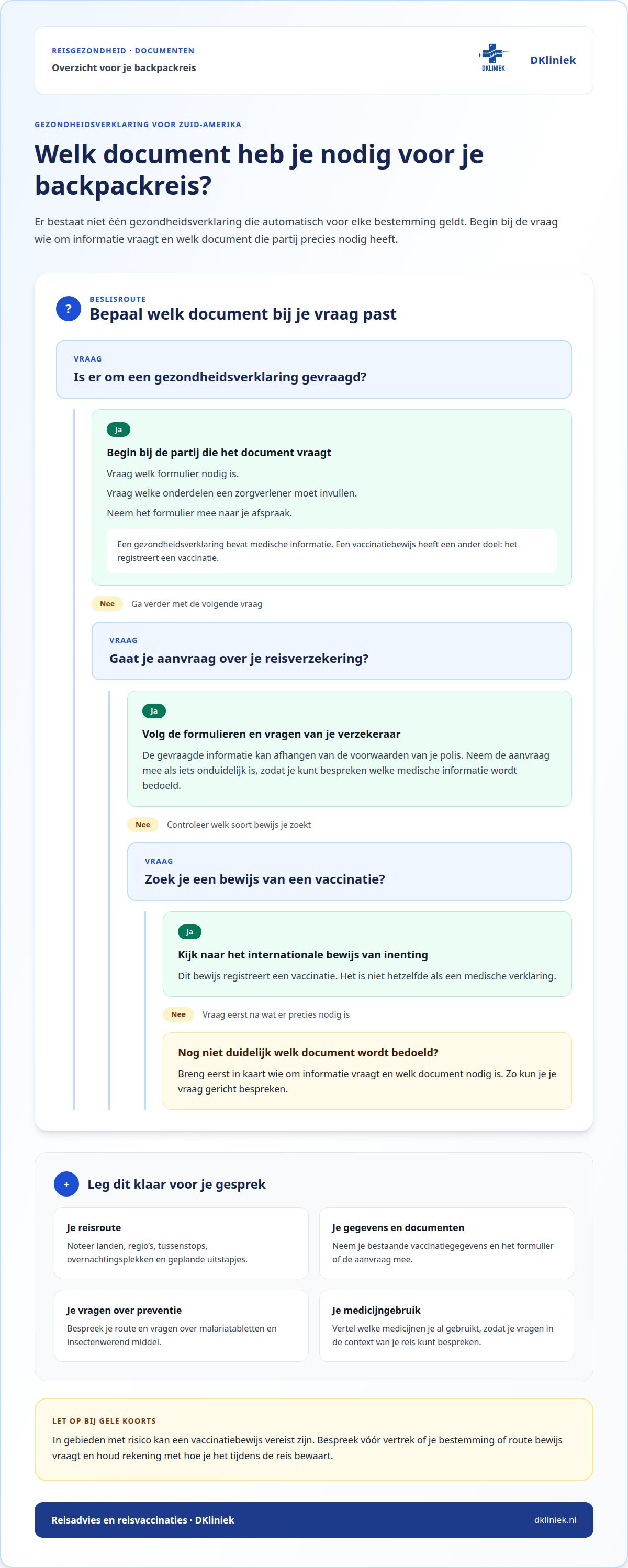
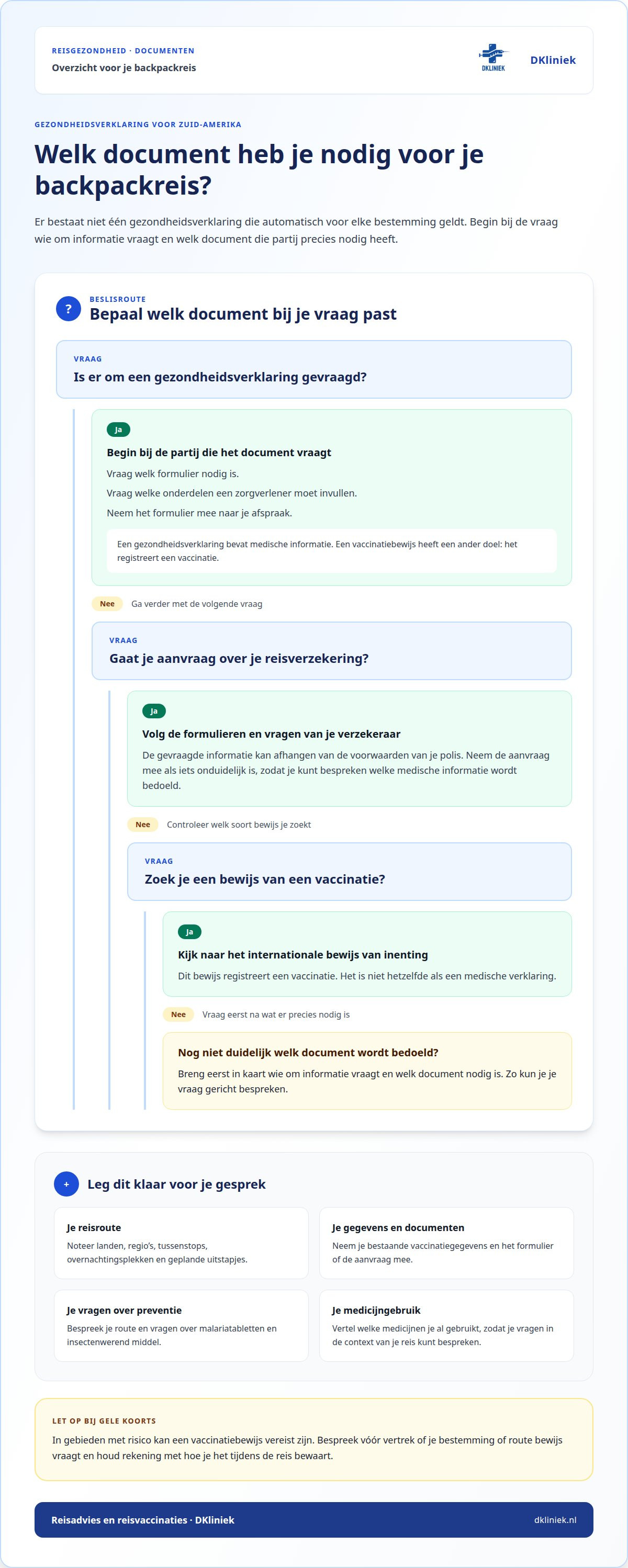
For a health declaration, start with the authority requesting the document. Ask which form is required and which sections must be completed by a healthcare provider. Bring the form to your appointment so you can discuss the questions specifically and avoid confusing proof of vaccination with medical information.
A travel insurer may request information according to the terms of your policy. Use the insurer's forms and questions. Bring the request to your appointment if anything is unclear, so you can discuss what medical information is meant. An International Certificate of Vaccination or Prophylaxis serves a different purpose: it records a vaccination.
Costs depend on the provider and what you request. A consultation, vaccination, and medical certificate are distinct components; therefore, ask for the current rates of the respective service. There is no single combined fee for a certificate at a travel clinic or general practitioner. If you are also traveling to high-altitude areas, add that destination to your travel details and discuss your questions about it during the consultation.
2. Malaria tablets and insect repellent
Discuss malaria tablets and insect repellent as separate topics. Your destination and itinerary are essential details. Note which countries and regions you are visiting, where you will stay overnight, and what excursions you are planning. A route through cities raises different questions than a stay in remote areas. This allows you to discuss what is relevant to your trip in a more targeted manner.
A prescription for malaria prophylaxis can be discussed during travel advice. Bring your travel itinerary and disclose any medications you are already using. Write down questions beforehand, for example regarding the prescription and the information required for it. If you are visiting Colombia, include the planned locations and accommodations in the discussion. Ensure the assessment is tailored to your situation, not to general travel stories.
You can also ask questions about insect repellent. Bring the name or packaging if you have already chosen a product, so you can ask targeted questions about the label instructions. Keep your planned activities handy as well. Nature reserves, stays in cities, and transportation between destinations are relevant parts of your itinerary.
Before the consultation, create a brief overview of your destination, accommodations, transportation, and medications. Also note your questions about malaria tablets and insect repellents. This helps you distinguish between questions about a prescription and questions about over-the-counter products for on the road. Personalized travel advice helps you discuss these topics within the context of your destination.
Do not make decisions about medication based solely on the name of a destination. Discuss your travel plans and questions during a consultation. This ensures your preparation aligns with the route you actually intend to travel, rather than with assumptions about an entire continent.
4. Health risks such as malaria and yellow fever
Traveling through South America can entail various health risks. In many countries, mosquitoes can transmit malaria, dengue, or zika. Which risks are relevant depends on your destination and itinerary. Visiting nature reserves requires different preparation than staying in cities. Also note stopovers and excursions: these can take you through different regions. This gives the doctor a clearer picture of your plans.
Health risks and travel advice differ by country and region. Your destination, visited areas, and activities determine which advice is relevant. Therefore, discuss your full itinerary, not just the country of arrival. A trip to Argentina and Patagonia requires a different discussion than a route through tropical regions.
Yellow fever deserves separate attention on routes to areas where the disease occurs. For such areas, proof of vaccination may be required. Discuss prior to departure whether your destination or route requires proof and how to carry it with you during the trip. Include it in your document folder and keep a copy separate from your luggage. This reduces the risk of discovering this requirement only at a border crossing.
Malaria, dengue, and zika are examples of mosquito-borne diseases. The risks vary by destination. A route along nature reserves and waterfalls can raise different questions than a city trip. Discuss your daily activities and overnight locations with a travel doctor. You can also ask how to help prevent mosquito bites.
Make your preparation concrete: write down countries, regions, and planned activities. Also mention any domestic travel, even if not yet finalized. Bring your vaccination records to the consultation so the travel advice can match your route and health. In addition, check prior to departure which documents you need for yellow fever areas. This is a practical step alongside packing.
In tropical regions, mosquito-borne diseases such as malaria, dengue, and zika may require attention. A route to Argentina and Patagonia calls for a different discussion. Present your complete itinerary, activities, and overnight stays to a travel doctor, and check in advance whether yellow fever areas require proof of vaccination.
4. Is a health declaration mandatory for Dutch backpackers visiting South America?
For backpackers, there is no single health declaration that automatically applies to every destination. Whether you need a medical form depends on the request of an authority, such as an insurer or travel organization. Travel advice is different from a completed declaration. Therefore, ask exactly what data and signatures the form requires.
A health declaration details medical information for a specific purpose. Proof of vaccination demonstrates that you have received a vaccine. The documents are therefore not interchangeable. For areas with yellow fever, proof of vaccination may be required. Discuss prior to departure which documents apply to your route and keep them with your travel documents.
Here is how to handle a request carefully:
- Read the request and note who must complete the declaration.
- Check which medical questions the organization is asking.
- Gather your vaccination records and information about medications.
- Ask the organization where and when you need to submit the document.
Complete medical questions fully and truthfully. Have sections requiring a medical assessment filled in by the requested healthcare provider. A doctor can clarify your medical situation, but does not determine which documents an insurer or destination requires. That requirement must be evident from the application or information provided by the relevant authority.
Organize documents by destination if you are traveling through multiple countries. Note, for example, whether your route passes through yellow fever areas. Keep the proof of vaccination separate from other forms so that you can quickly find the right document during a layover or transit. Also keep a copy with your travel details. This prevents confusion between a medical certificate, an insurance form, and proof of vaccination.
If you need a medical certificate, discuss beforehand with a doctor what it is intended for and what questions are on the form. This allows the information to align with the request. In addition, organize your vaccination records and travel documents before departure.
DKliniek
DKliniek can help you review your travel preparation when you have questions about vaccinations or a medical certificate. During a travel vaccination consultation, you discuss your route and the destinations you will visit. This gives you the opportunity to ask questions about relevant vaccinations, such as yellow fever or DTP, and about proof of vaccination. Bring your vaccination records and any application forms with you, so your consultation addresses what you need to know.
Even if you are unsure what health information an organization is requesting, you can bring the specific application to DKliniek. A medical certificate and proof of vaccination serve different purposes. Discuss what information is required so that you gain clarity on the health questions relevant to your travel preparation.
Schedule an appointment directly at DKliniek.
Personalize your preparation
Make room for your own questions. Consider not only what is on a form, but also what information helps you embark on your trip with confidence. Write down what you want to know about your situation or about applying for a medical certificate, so you can discuss these points at ease.
A health declaration for backpacking in South America is not a goal in itself. The aim is to know which preparation suits your trip and which documents you need. Align these choices with your plans so you depart with a better overview. Discuss your questions about travel vaccinations or a medical certificate at DKliniek.
Would you like to discuss your travel health or schedule an appointment? Schedule an appointment directly at DKliniek. With personalized preparation, you take a careful step toward your adventure.
Frequently Asked Questions
What is a health declaration for backpacking in South America?
A health declaration is a medical form containing information about your health for a specific purpose. The organization requesting it determines which questions it contains. This could, for instance, concern travel insurance or an application related to your trip. This document differs from proof of vaccination: the latter records a vaccine, not your general health.
Which countries in South America require a health declaration or medical certificate for travelers?
There is no general list of countries that applies to every Dutch backpacker. Whether you need a certificate depends on your destination, travel purpose, and the authority requesting the document. A stopover may also be relevant. Therefore, check the requirements for all countries on your itinerary and the precise wording of the request, not just your first destination.
Which vaccinations are recommended for backpacking in South America?
Which vaccinations are appropriate for your trip depends on your itinerary, health, and previous immunizations. A travel doctor can, for example, discuss whether vaccination against yellow fever, DTP, or hepatitis A is relevant for your plans. This is not a standard list for everyone. Bring your vaccination records and mention remote stays, city trips, and activities that involve visiting various regions.
Is proof of yellow fever vaccination mandatory, and for which countries or border crossings?
Proof of yellow fever vaccination may be required for travel to areas with yellow fever. Which requirement applies to your trip depends on your destination and itinerary. A general list for all countries or border crossings therefore does not provide a personalized answer. Also discuss stopovers and transits. Distinguish between the vaccination itself and the document proving that immunization.
How long before departure should you arrange vaccinations and health documents?
Arrange your preparation well in advance of departure, allowing enough time to discuss your itinerary and vaccination history. What is required depends on the vaccinations suitable for your trip and whether multiple doses are needed. Also collect forms from your insurer or travel organization. If your route changes, for example due to an additional country or stopover, discuss again which documents are relevant.
What rules apply to medications, medical devices, and a medication certificate while backpacking?
Bring your prescribed medications and discuss medication and any altitude sickness medication with a doctor. Also carry copies of prescriptions. Ask the relevant authority which rules apply to medical devices or a medication certificate.
Schedule an appointment directly at DKliniek.

Article by
Y. Daia
Drs. Yassine Daia is a physician specializing in travel medicine and vaccinations. As the founder of DKliniek, he advises and guides travelers on preparing safely for their journey, focusing on personal health and destination-specific risks. DKliniek is officially affiliated with the LCR (National Coordination Centre for Travel Advice) and provides expert, reliable travel health advice, including vaccinations for Hajj and Umrah, among others.
Disclaimer
The information on this page is intended solely for general informational purposes and does not replace personalized medical advice. For tailored advice aligned with your health and travel destination, we recommend scheduling a consultation at DKliniek. Although we compile this information with care, no rights can be derived from it. DKliniek is not liable for any damages resulting from the use of this information.