Travel vaccinations for young children: which ones are needed
Would you rather arrange this straight away?
Book an appointmentWhich travel vaccinations does your child need? That primarily depends on the destination, age, and vaccinations your child has already received. When considering travel vaccinations for a family with young children, hepatitis A, for example, may be relevant. For certain destinations, an MMR vaccination can be given as early as 6 months of age. The yellow fever vaccination can be given from 6 months, but preferably from 9 months.
It is understandable that you want to know which jabs are needed and whether your child's age makes a difference. Travel advice varies by family: the itinerary and existing protection from the National Immunisation Programme play a role. Hepatitis A vaccination can be given to children from one year of age.
In this article, you will learn how destination and age factor in, what role hepatitis A, MMR, and yellow fever can play, and why it is wise to discuss vaccinations in good time. This will give you a clearer overview of immunisations for abroad and the travel advice that suits your family.
Key Takeaways
- Have travel advice tailored to the destination, itinerary, and your child's age. Previous vaccinations may also be taken into account.
- Discuss which protection against hepatitis A, MMR, and rabies is appropriate for your trip and your child's age.
- Protect your child from mosquitoes with protective clothing and a mosquito net. If your child develops a fever during or after travelling to a malaria area, seek medical attention within 24 hours.
- If a country requires yellow fever vaccination, it must be administered at least ten days before entry. Preferably, schedule an appointment for travel advice at least 6 weeks before departure.
Which vaccinations does my child need for our trip?
The itinerary, accommodation, and planned activities partly determine which vaccinations are relevant. When it comes to travel vaccinations for a family with young children, age and previous vaccinations also play a role.
Protection against malaria and mosquitoes
Discuss the mosquito risk based on the entire route, not just the first destination. Staying in a city can involve different considerations than staying with family in rural areas or taking a trip to a remote area. Therefore, make a note of where you will be staying overnight and which excursions are planned.
Also mention which vaccinations your child has already had and whether you have any questions about malaria. This ensures the travel advice aligns with your plans and your child's situation. The assessment depends not only on the destination, but also on where and how you stay.
Travel vaccinations against serious diseases
Travel vaccinations help determine which protection against diseases may be relevant for a specific trip. The destination and activities guide the consultation. Think of a family trip with multiple stops, visiting family, or staying off the beaten tourist track.
Bring your child's vaccination record to the consultation. Also mention any previous reactions to vaccines and any health concerns. This allows their existing schedule to be taken into account and lets you discuss which additional protection is relevant for the trip.
Vaccinations for travel to family or remote areas
When visiting relatives, you might stay in one place longer, or conversely, visit various locations. For travel vaccinations for a family with young children, this information is crucial, alongside age and vaccination history. Therefore, outline the itinerary, duration of stay, and planned day trips.
The distance to medical facilities can also be a practical consideration when travelling to remote areas. Discuss such circumstances during the travel consultation so they form part of the evaluation. A personalised travel vaccination consultation can address both the destination and your travel plans together.
Hepatitis A, MMR, rabies, and other travel vaccinations
The destination, travel duration, and previous vaccinations help determine which jabs are appropriate. The National Immunisation Programme and your child's age are also taken into account.
Hepatitis A in young children
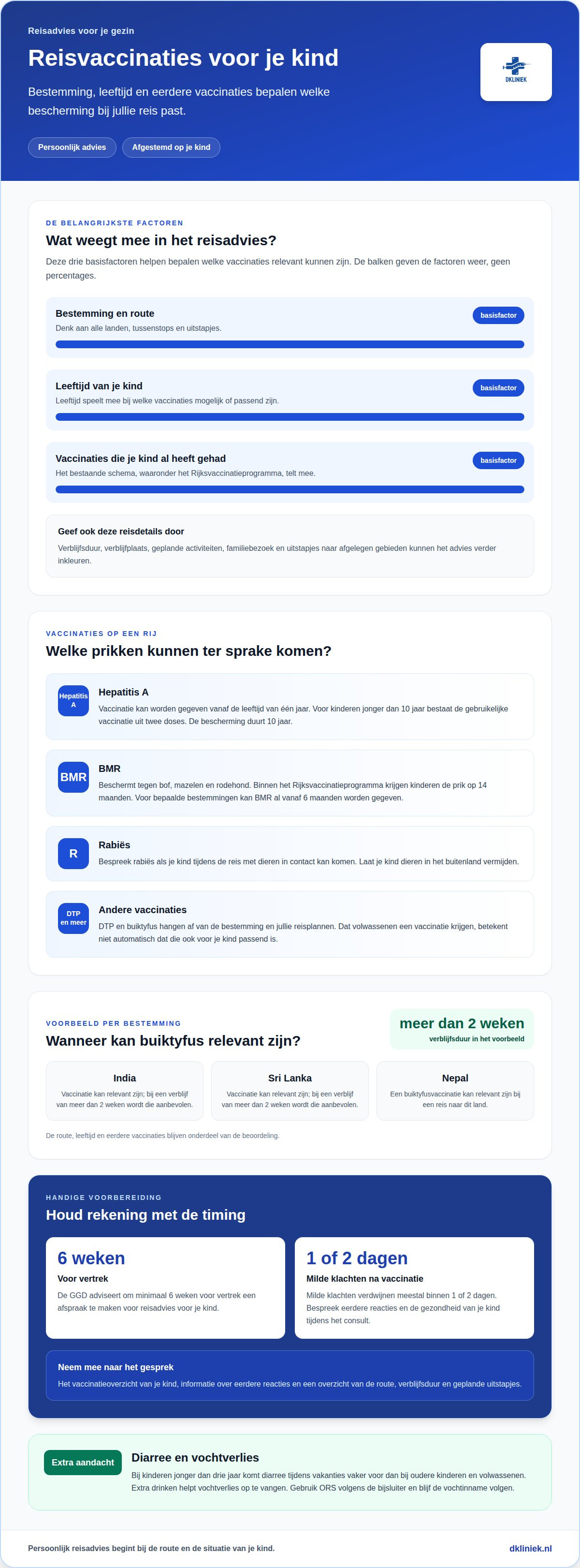
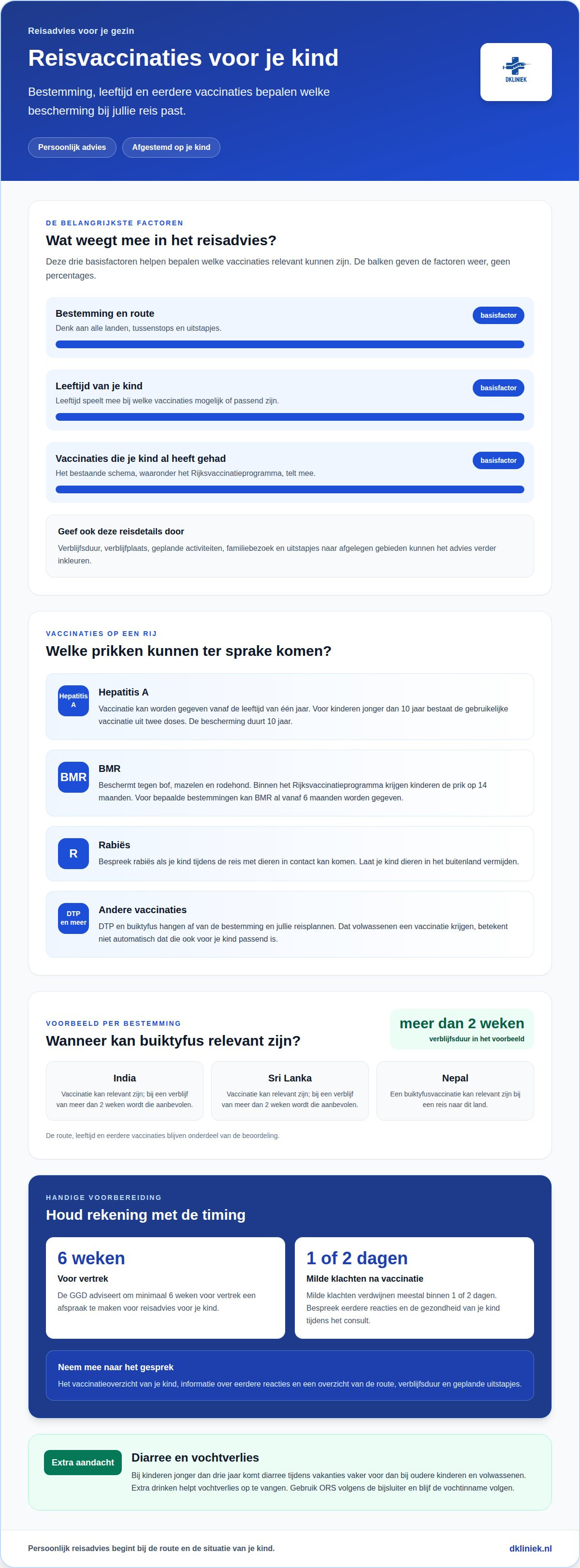
Hepatitis A vaccination can protect children from one year of age against this infection. For children under 10 years of age, the standard course consists of two doses, providing 10 years of protection. A first dose given before 6 months requires an additional dose according to the outlined guidelines. Also discuss which hepatitis vaccinations have been given previously. This ensures the advice is tailored to your holiday and the protection your child already has.
MMR, rabies, and other vaccinations
The MMR vaccination protects against mumps, measles, and rubella. In the National Immunisation Programme, children receive this jab at 14 months; for certain destinations, MMR can be given as early as 6 months. Rabies warrants attention on trips where contact with animals is possible. Ensure your child avoids animals abroad. Other vaccinations, such as DTP (diphtheria, tetanus, and polio) or typhoid fever, depend on the destination and travel plans, not simply on whether adults receive them.
Having travel vaccinations planned by an expert before departure
The Municipal Public Health Service (GGD) advises scheduling an appointment for your child's travel advice at least 6 weeks before departure. This time allows for the itinerary, age, and previous vaccinations to be factored in. Health insurance reimburses vaccinations and consultations according to the terms of your policy. Costs depend on the vaccinations and the consultation required for your trip. Information on reimbursements for travel vaccinations will help you check your policy conditions.
Side effects and risks in young children
Mild symptoms after vaccination usually clear up within 1 to 2 days. When planning, factor in your child's age and the date of travel. This ensures there is sufficient time to administer vaccinations at the appropriate moment. Discuss previous reactions to vaccinations and your child's overall health during the consultation. A pregnant parent can also discuss personal questions regarding travel vaccinations, ensuring the advice suits the entire travel party.
Travel vaccinations for diseases occurring in specific countries
Which diseases require attention depends on the countries, itinerary, and duration of the trip. Staying with family may involve different risks than a short city break. Therefore, also include remote areas and your child's age in the travel advice. Previous vaccinations, such as those from the National Immunisation Programme, help determine what protection is already present.
Typhoid fever and travel destination
When travelling to India, Sri Lanka, or Nepal, a typhoid fever vaccination may be relevant. For stays of more than two weeks in countries like India or Sri Lanka, the vaccination is recommended. Discuss the complete route, not just the primary destination, so that family visits and trips outside major cities are also accounted for. Your child's age and previous vaccinations are also part of this assessment.
Vaccinations are just one part of travel preparation. Which jabs are relevant depends on the diseases present in the country visited and your plans while there. Share where your child will be staying and for how long. Also mention which vaccinations your child has already had and when. In this way, the advice aligns with the trip while respecting the routine vaccination schedule.
Preventing diarrhoea and managing dehydration
In children under three years of age, holiday diarrhoea occurs more frequently than in older children and adults. Extra fluids help offset fluid loss; use ORS (oral rehydration solution) according to the patient leaflet and continue to monitor fluid intake. Anti-diarrhoeal medications are not recommended for children under six years of age. Therefore, do not use them as a quick fix during the trip.
When diarrhoea occurs, monitor your child's temperature. A fever higher than 39 degrees Celsius is a reason to see a doctor. Note when the symptoms started and how often your child has diarrhoea. This information helps evaluate the situation. In young children, dehydration can develop more quickly, so offer extra drinks and follow the dosage on the ORS package leaflet.
Yellow fever and travel destinations
A yellow fever vaccination may be mandatory for entry into a country. Which immunisations apply depends on your destination and travel route. Discuss this well before departure, especially if your child is still young. Age plays a significant role in determining whether and when this jab is appropriate.
Children can receive a yellow fever vaccination from 6 months of age, but preferably from 9 months. These age thresholds are important when planning a trip to an area for which the vaccination is relevant. Discuss the destination, itinerary, and your child's age together. This allows the advice to account for both the journey and the vaccination schedule.
If a country mandates the vaccination, it must be administered at least ten days prior to entry. Therefore, when planning, take into account not only the departure date but also the date you enter the country. This is especially important for multi-destination itineraries. A layover or onward travel to another country can alter the timeline.
A child younger than 9 months falls below the age at which the vaccination is preferably administered. The possibility from 6 months onward does not mean that every trip requires the same advice. The destination and age are decisive. Also bring details of vaccinations already administered under the Dutch schedule. This provides a complete picture of existing protection and the required vaccination timings.
When it comes to travel vaccinations for young children, yellow fever is therefore both a destination and an age question. Ensure the itinerary and entry date are factored into the consultation. Discuss the timing of the yellow fever vaccination during the travel consultation, so it is clear whether the jab can be given in good time before the trip.
In this article, only the yellow fever vaccination is mentioned as potentially mandatory; this varies by country and itinerary.
DKliniek: Travel Vaccination
DKliniek helps you tailor your child's travel vaccinations to the destination, itinerary, and age. Schedule a travel consultation to discuss which immunisations are suitable and how they complement previous vaccinations. Bring your travel details and vaccination records so the assessment takes your full situation into account.
At DKliniek, you can obtain travel vaccinations, including yellow fever and DTP vaccines. The meningococcal ACWY vaccine is also available. Which jabs are relevant varies per trip. During a personal consultation, you can ask questions regarding your child's vaccination schedule.
Book an appointment directly with DKliniek.
Tailor preparation to your family
Approach travel advice as a question for the entire family. This allows you to discuss how the plans of parents and children connect and which points of attention apply to each family member. Personalised coordination helps clarify choices regarding travel vaccinations for a family with young children.
You do not have to determine which vaccinations are needed on your own. Discuss your questions, such as how the advice connects with your travel plans or your child's vaccination history. An expert can factor these in during the consultation, giving you greater clarity as you continue planning.
Would you like to discuss your family's situation? Contact DKliniek. With clear travel advice, you can approach the rest of your preparations with confidence.
Frequently Asked Questions
How do you keep your family healthy during the trip?
Combine mosquito protection with attention to hydration and daily safety. Use protective clothing and a mosquito net in areas where mosquito-borne diseases occur. If your child has diarrhoea, give extra fluids and use ORS according to the package leaflet. Ensure children are always supervised by an adult while swimming. Wash any wound immediately with soap and water for at least 15 minutes following an animal bite, scratch, or lick.
Is the National Immunisation Programme sufficient for long-haul travel?
Not always. The National Immunisation Programme protects against infectious diseases, but travel may require supplementary vaccinations. The destination and planned activities determine what protection is relevant. For example, a child may already have had an MMR vaccine under the routine schedule, whereas for certain destinations, an earlier MMR vaccination may be considered. Bring the vaccination record to the travel consultation so that existing protection is taken into account and unnecessary duplicate jabs are avoided.
Can my child become ill from mosquito bites?
Yes. In areas where malaria is present, mosquitoes can transmit the disease through their bites. Use protective clothing and a mosquito net, and follow the instructions for prescribed antimalarial medication. For children under 2 years of age, insect repellent should contain a maximum of 30% DEET. If your child develops a fever during or after staying in a malaria area, seek medical attention within 24 hours. Be sure to inform the doctor where you have travelled.
Which travel vaccinations are recommended by country and itinerary for families with young children?
The advice is tailored to the countries, itinerary, duration of stay, and your child's age. A stopover or visiting relatives may introduce different considerations than the main location alone. Previous vaccinations also factor in. For example, for an extended stay in India or Sri Lanka, a typhoid fever vaccination may be relevant. Therefore, discuss all destinations and excursions, even if they only cover part of the holiday.
From what age can children receive travel vaccinations and which vaccines are suitable?
The age limit varies by vaccine. Hepatitis A can be given from one year of age; typhoid fever vaccination from two years. For certain destinations, MMR can be considered from 6 months. Yellow fever vaccination can be given from 6 months, but preferably from 9 months. Which jabs are suitable also depends on previous vaccinations and the specific journey. A travel consultation weighs these factors together so that the schedule suits your child.
What are the recommended vaccinations against hepatitis A, typhoid fever, rabies, and yellow fever for children?
There is no fixed combination for every child: the destination and travel plans determine which vaccinations are relevant. Hepatitis A may be appropriate for certain destinations; typhoid fever may be recommended for an extended stay in India or Sri Lanka. Discuss rabies especially if animal contact is possible, and keep your child away from animals. The relevance of yellow fever depends on the destination and age. Bring the itinerary and vaccination history to the consultation.
Book an appointment directly with DKliniek.

Article by
Y. Daia
Drs. Yassine Daia is a physician specialising in travel medicine and vaccinations. As the founder of DKliniek, he advises and guides travellers on preparing safely for their journey, with careful attention to personal health and destination-specific risks. DKliniek is officially affiliated with the National Coordination Centre for Travel Advice (LCR) and provides expert and reliable travel advice, including vaccinations for the Hajj and Umrah, among others.
Disclaimer
The information on this page is intended solely for general informational purposes and does not replace personalised medical advice. For tailored advice aligned with your health and travel destination, we recommend scheduling a consultation at DKliniek. Although we compile this information with care, no rights can be derived from it. DKliniek is not liable for any damages resulting from the use of this information.